
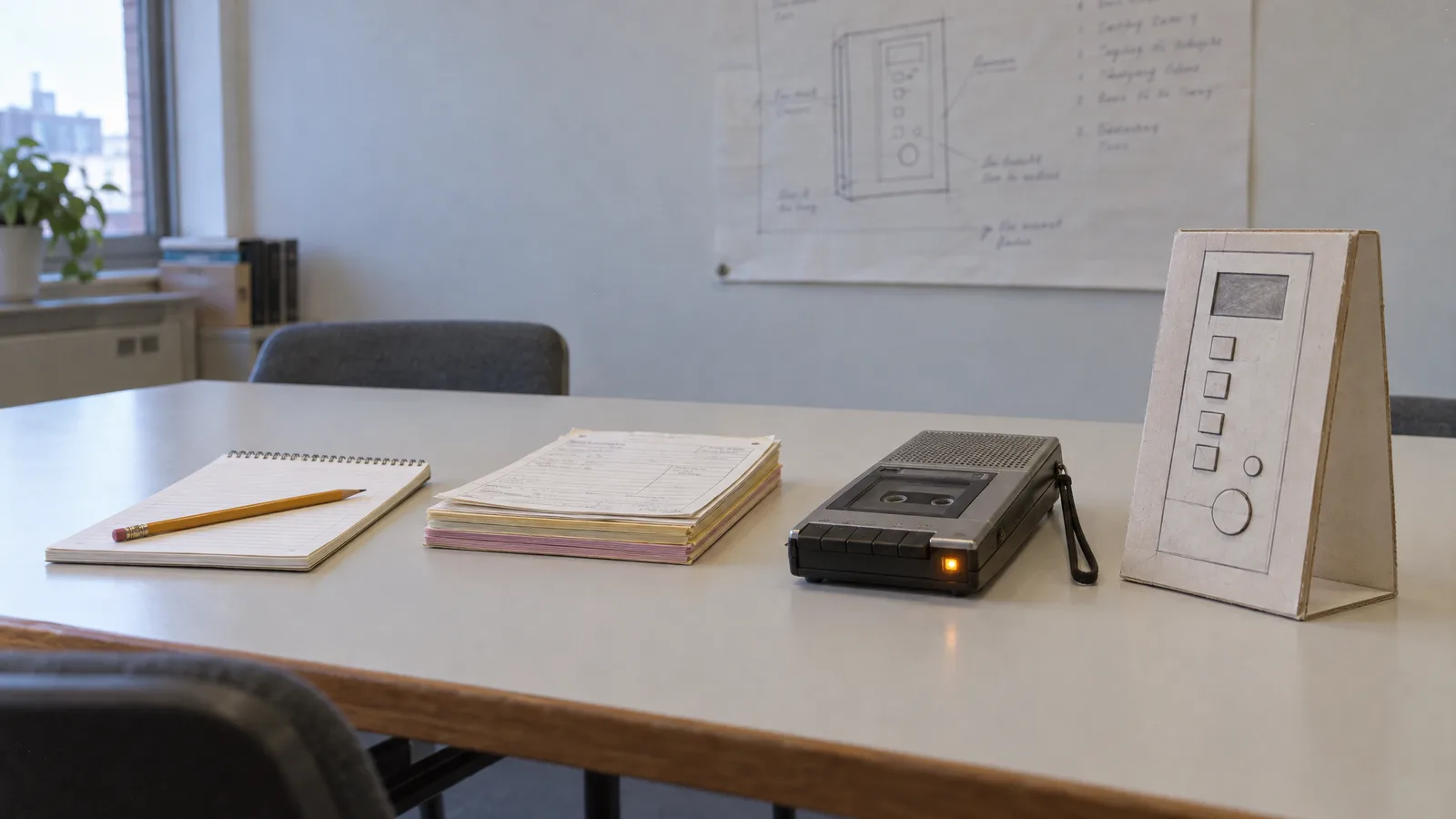
The best requirements gathering techniques are the ones that match what you still don’t know. Use interviews to learn what individual people need. Use workshops to settle conflicts between them. Use observation and document analysis to see how work really happens, and use prototypes to test ideas before you build them. No single method is enough, so most software projects combine three or four. This guide explains what each technique reveals, how to pick a combination, and how to turn the results into requirements a developer can build and a stakeholder can sign off.
TL;DR
- Gathering is the whole job: identifying, documenting, analyzing, validating and signing off needs. Elicitation is the active part where you draw needs out of people.
- Interviews and workshops express needs. Observation and document analysis show how work is done today. Prototypes show what could be.
- Start with goals, context and stakeholders, and only then collect detailed requirements.
- Make quality requirements measurable, so “fast” becomes a number someone can test.
- Requirements that nobody validated are useless, so end every round with a review.
What requirements gathering means (and how it differs from elicitation)
Requirements gathering is the broad process of identifying, documenting and organizing what a system needs to do. It includes finding stakeholders, eliciting needs, analyzing them, validating them and getting sign-off. Elicitation is the active subset: drawing out needs, expectations and constraints from users, engineers, regulators and domain experts.
The vocabulary is debated. Requirements expert Robin Goldsmith argues that “gathering” and “eliciting” mislead, because requirements are not lying around fully formed. He prefers to talk about discovering requirements by analyzing data. Karl Wiegers and Candase Hokanson make a similar point: a good analyst treats elicitation as exploration and discovery, not just collection.
The practical lesson is that people will not hand you a finished list. A founder says “we need an app with a dashboard”. What the business needs is usually something else underneath: fewer manual reports, faster onboarding, fewer support tickets. Your techniques exist to get from the first statement to the second.
Before any technique: goals, context and stakeholders
Research from the University of Zurich’s requirements engineering group is clear on the order of work. Before eliciting details, you clarify the system’s goals and vision, consider its context, and identify stakeholder roles and their representatives. Skipping this step is the most common reason a project’s first workshop produces a long, unfocused wish list.
Do three things first:
- Write the goal in one or two sentences. For example: “Reduce the time our sales team spends creating quotes from 40 minutes to 10.” If you can’t, that is your first workshop topic.
- Map the context. Which systems, teams, suppliers, laws and existing processes touch the product? A shop connected to an ERP and a payment provider has requirements that live outside the shop.
- List stakeholder roles, then name a real person for each. Think of users, buyers, operations staff, finance, IT and legal. Where you can’t reach a real person, the same Zurich material suggests using personas, fictitious characters that represent groups of users with similar needs, values and habits.
If you are new to an organization, start by reading. Existing system documentation and organization charts are a foundational way to understand business objectives before you take up anyone’s time.
The main requirements gathering techniques
A systematic review of elicitation studies found that each technique reveals different things: interviews clarify individual needs and motivations, while observation highlights real-world workflows. The Zurich course material puts it compactly: interviews and workshops can express needs, prototypes can demonstrate opportunities, and observation helps analyze work as it is. Here is how that plays out in practice.
Interviews
A one-to-one conversation is the workhorse. It suits people who won’t speak freely in a group: the finance lead who knows the real reporting pain, the operations manager who works around a broken tool.
- Reveals: individual needs, motivations, vocabulary, hidden constraints.
- Use when: you have few stakeholders, sensitive topics, or need depth.
- Tips: ask about the last time something went wrong, not what they “want”. Ask “why” until you reach a business reason. Keep to 45 minutes and send a written summary afterward.
Workshops
A workshop puts several stakeholders in a room (or a video call) with a clear agenda. It is the fastest way to find conflicts and settle them.
- Reveals: disagreements between departments, priorities, shared language.
- Use when: several groups depend on the same product, or you need decisions, not just information.
- Tips: invite the person who can decide, not only the person who knows. Finish with a ranked list, not an open one. Five to eight people is manageable.
Observation and job shadowing
Watching people work shows what interviews miss, because people describe the official process and then do something different. A warehouse employee may keep a spreadsheet beside the official system. That spreadsheet is a requirement.
- Reveals: real workflows, workarounds, interruptions, tools used in parallel.
- Use when: you are replacing or automating an existing process.
- Tips: spend half a day per role, take notes on what people do rather than what they say, and ask about each workaround afterward.
Document analysis
Existing manuals, process descriptions, contracts, support tickets, analytics and old specifications tell you what the organization already knows. They are also cheap to read and don’t take anyone’s time.
- Reveals: current rules, data fields, integrations, recurring problems.
- Use when: at the start of any project, and especially when migrating a legacy system.
- Tips: treat documents as claims to verify. Old documentation is often outdated, so check it against observation.
Surveys and questionnaires
Surveys reach many people at low cost. They work for confirming something you already suspect, such as which of five features customers value most. They work poorly for discovering things nobody has thought of.
- Reveals: patterns across a large user group.
- Use when: you have many users and a specific question.
- Tips: keep it under ten questions, and run a few interviews first so your questions are the right ones.
Brainstorming
Brainstorming generates options quickly. It suits early-stage products where the problem is clear but the solution isn’t. Its output is raw ideas, not requirements, so follow it with a prioritization step.
- Reveals: possible solutions and ideas stakeholders hadn’t voiced.
- Use when: you are at the idea stage or a workshop has stalled.
- Tips: separate generating ideas from judging them, then score the ideas against the goal you wrote down.
Prototyping
A clickable mock-up or a rough working version lets people react to something concrete. Stakeholders often can’t say what they need but know immediately what is wrong with a screen.
- Reveals: usability problems, missing steps, unspoken expectations.
- Use when: the interface is central, the users are unfamiliar with the idea, or stakeholders disagree about what “it” looks like.
- Tips: test with real users, not only with the project sponsor. Throw away the prototype’s assumptions, not just its pixels.
User stories and use cases
User stories (“As a sales rep, I want to duplicate a past quote so that I can send a new offer in minutes”) and use cases or scenarios turn findings into a form that a team can build from. The Zurich material lists scenarios and use cases, glossaries, process models and object models among the analysis techniques that shape unstructured information into proper requirements.
- Reveals: gaps in flows, edge cases, and which steps matter most to users.
- Use when: after elicitation, to structure what you heard.
- Tips: attach acceptance criteria to each story, so the team and the client agree on what “done” means.
How to choose and combine techniques
The International Requirements Engineering Board states that there is no universal requirements process: it must be tailored to the development context, the type of project (linear or agile) and how available stakeholders are. So choose by asking three questions.
1. What do you not know yet?
| Unknown | Best techniques |
|---|---|
| What problem matters most | Interviews, document analysis |
| How work is done today | Observation, document analysis |
| Who wants what, and where they conflict | Workshops |
| What the solution should look like | Prototyping, brainstorming |
| How widespread a need is | Surveys |
| What the team should build next | User stories with acceptance criteria |
2. Who can you reach, and how much of their time do you have? Five busy executives are better served by short interviews and one decision workshop than by a series of long meetings. Hundreds of end users call for a survey backed by a handful of interviews.
3. How expensive is a wrong guess? A marketing website can be corrected after launch. A payment flow, a system that talks to an ERP, or a regulated process can’t, so spend more time on observation and prototyping there.
Three combinations that work
- New product or MVP: stakeholder interviews, a goal-setting workshop, a clickable prototype tested with five target users, then user stories. This keeps the first release small and based on evidence.
- Replacing a legacy system: document analysis, observation of each user role, interviews about workarounds, then a workshop to decide which old behaviors to keep. Old systems hide business rules that nobody remembers writing.
- Automating a repetitive process: observation of the process end to end, a short workshop to agree on exceptions, and a prototype of the automated flow run on a sample of real cases.
In each case, mix a technique that collects what people say with one that checks what they do.
Quality requirements: the ones people forget
Stakeholders talk about features. They rarely mention speed, security, availability or ease of use until something fails. The Zurich research lists neglected quality requirements and constraints among the most common problems, and advises you elicit quality requirements explicitly.
Vague statements need numbers. A requirement such as “the system shall be fast” is, according to the same source, ambiguous and hard to verify, but can be quantified or operationalized. For example:
- Instead of “fast”: “Search results appear within two seconds for 95 percent of requests.”
- Instead of “secure”: “Staff sign in with two-factor authentication, and customer data is stored in Switzerland.”
- Instead of “easy to use”: “A new employee creates a quote without training in under ten minutes.”
Ask the questions directly: How many users at once? What happens if the system is down for an hour? Which data is personal? Researchers from the University of Zurich and FHNW also caution that quality models must be tailored to the project’s context to work as elicitation frameworks, so use checklists as prompts, not as scripts.
Common problems and how to handle them
The same Zurich material names the problems you will meet: inconsistent needs or terminology, stakeholders who can’t express or don’t know their needs, hidden agendas, and solution-focused thinking. Here are practical responses.
- Two departments want opposite things. Don’t resolve it by email. Put both in a workshop with the person who owns the goal, and decide against the written goal.
- A stakeholder says “just build X”. Ask what happens today without X and what changes with it. People often describe a solution when they mean a problem.
- Nobody knows what they need. Show them something. A rough prototype or a similar product often unlocks more than another meeting.
- Terms mean different things. Keep a glossary. “Customer” may mean a buyer to sales and a user account to engineering.
- A key person is unavailable. Name a delegate with authority, or use a persona and flag the assumption so you check it later.
- Scope keeps growing. Rank requirements (must, should, could) at every workshop, and record who requested each item and why.
Documenting, validating and keeping requirements current
Write requirements in a form the reader needs. A business requirements document describes high-level goals. A system requirements specification, called a Pflichtenheft in German, describes what the system will do. Swiss clients often know the German term, and it is worth asking whether a Pflichtenheft is expected in a tender or contract.
A workable minimum for a small project:
- Goal and success measures.
- Stakeholder roles and who decides.
- User stories or use cases, ranked by priority, each with acceptance criteria.
- Quality requirements with numbers.
- Integrations, data, and constraints such as budget, deadlines and legal rules.
- Open questions and assumptions, with owners.
Then validate. The IREB handbook is blunt that non-validated requirements are useless. Validation can be a walkthrough with stakeholders, a prototype review, or test cases written from the acceptance criteria before building starts. Sign-off should mean that people with authority have read the document and agree it matches their needs.
If you work in a regulated sector such as medical devices or automotive, expect more. Regulated industries often demand traceability evidence in design history files and certification packages under standards such as FDA 21 CFR 820.30 or ISO 26262. Ask your compliance contact which standards apply before you choose a documentation format.
Finally, keep the document alive. Research at the University of Zurich shows that up-to-date requirements specifications prevent the loss of the rationale behind past decisions and make later feature discussions easier. When a decision changes, record the reason beside it.
A step-by-step process you can start this week
- Define the goal and success measures in writing, and have the sponsor confirm them.
- List stakeholders and context: roles, systems, rules, existing documents.
- Read first: documents, tickets, analytics, org charts.
- Interview one person per role, about recent real situations.
- Observe the two or three most important workflows.
- Run one workshop to resolve conflicts and rank priorities.
- Prototype the riskiest part and test it with real users.
- Write stories with acceptance criteria and measurable quality requirements.
- Validate and sign off, then plan a review whenever scope changes.
For a small product, steps 1 to 8 often fit into two to three weeks of part-time effort from the client side. The more stakeholders and integrations, the longer it takes, and that time is cheaper than rewriting software later.
Getting requirements right with a senior team
Requirements work is where projects are won or lost, and it depends on who is in the room. At Ampersand, a small Zurich studio, senior engineers take part from the first consultation through to handover. That is meant to keep the people who heard your needs the same people who build the solution, so requirements don’t get lost or rewritten halfway through. If you are planning a website, app, platform, integration or migration, you can see how we structure our work on our pricing and services page, or start a conversation through ampersand.ch.
FAQ
What is the difference between requirements gathering and requirements elicitation?
Gathering is the entire process: identifying stakeholders, eliciting, documenting, analyzing, validating and signing off. Elicitation is the active part within it, where you draw needs and constraints out of users, experts and other stakeholders. In practice, the terms are often used interchangeably.
Which requirements gathering technique is best?
None is best on its own. Interviews give depth, workshops resolve conflicts, observation shows real workflows and prototypes test ideas. Pick the mix according to what you don’t know yet, who you can reach and how costly a wrong assumption would be.
How do you gather requirements for a software project?
Start with the goal, the context and the stakeholders. Then combine reading, interviews, observation and a prioritizing workshop, and test risky parts with a prototype. Write stories with acceptance criteria and measurable quality requirements, and have the people with authority validate them.
What are the techniques used in requirements analysis?
Analysis shapes what you collected into clear requirements. Common tools include glossaries, scenarios and use cases, process or activity models, behavior models, object or class models and hierarchical structures of goals and features.
How do you handle stakeholders who can’t say what they need?
Show them something concrete, such as a prototype, a screen from a similar product or a sample report. Observe how they work instead of asking only what they want. Where no real person is available, use a persona and mark it as an assumption to check.
Sources
- Requirements Gathering: Process and Best Practices (Jama Software)
- Use elicitation techniques to discover software requirements (TechTarget)
- Requirements Elicitation, Practice 6 (InformIT)
- Requirements elicitation techniques: a systematic review (IET Software)
- Requirements Engineering, Chapter 4: Elicitation (University of Zurich)
- Elaboration of Requirements (University of Zurich)
- Documenting Requirements (University of Zurich)
- Towards a Modern Quality Framework (University of Zurich and FHNW)
- Supporting Requirements Update During Software Evolution (University of Zurich)
- IREB Handbook, Foundation Level
- Chapter 5: Background reading (De Montfort University)
Talk to us
Have a project this touches on?
A free 10-minute call is the fastest way to find out whether we are the right studio for it.
Book a free 10-min callKeep reading
More articles.
RFP for Web Development: How to Write One That Works
How to write a web development RFP: what to include, how to set budget and timeline, score proposals, and which Swiss rules apply. With a template outline.
Read articleGraphQL vs REST: How to Choose the Right API in 2026
GraphQL or REST? Compare data fetching, performance, caching, security and real-time support, and see which fits your product, team and budget.
Read articleProject Estimation Accuracy: How to Get Software Estimates You Can Trust
Why software estimates miss, which estimation techniques work, and how to make your numbers more reliable over time, with research-backed steps and examples.
Read article