
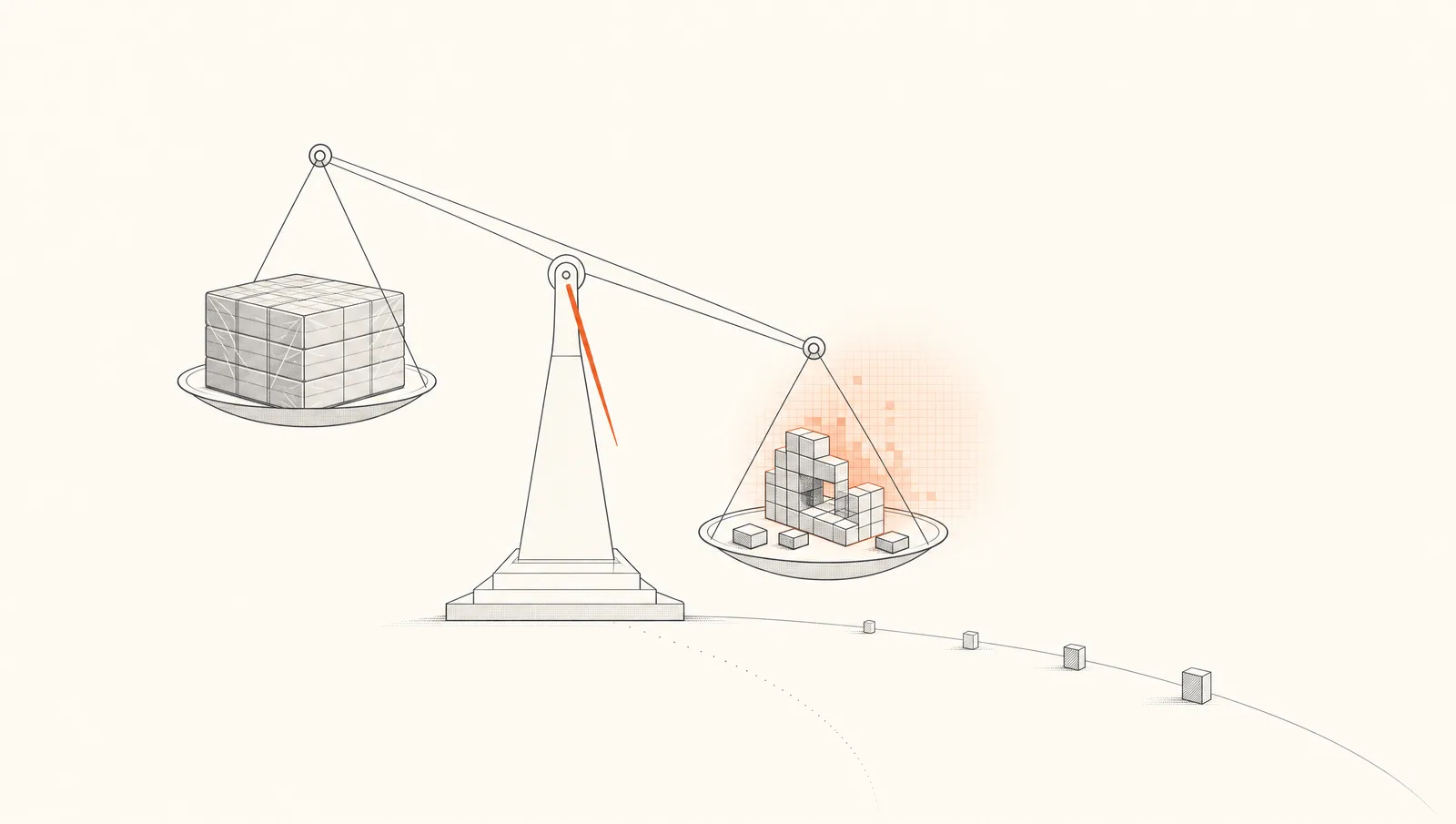
In most cases, buying or blending beats a full custom build unless the capability is a clear customer-facing differentiator and you can sustain ownership for five or more years. The Buy/Build/Blend framing that dominates enterprise procurement today exists because pure binaries rarely survive contact with real budgets. What follows is a scoring checklist, a cost model, and a live example of the framework applied to a real project.
TL;DR:
Buying SaaS is generally more cost-effective for small-scale or quick-launch workflows, especially if a vendor already covers most required functionalities.
Long-term ownership costs for custom builds often surpass initial savings once maintenance, security, and knowledge retention expenses are included, sometimes making buy more economical.
Speed to market within 30 to 90 days heavily favors buying, as development timelines often exceed operational needs and risk operational gaps for teams lacking deep engineering resources.
Flawed cost comparisons, such as using first-year build estimates against multi-year SaaS contracts, tend to underestimate true build costs and lead to poor decision-making.
Employing a weighted scoring matrix helps to make objective buy, build, or blend decisions that account for differentiation, TCO, integration complexity, and time-to-market.
Build vs Buy Software: The Buy/Build/Blend Framework
Three categories cover almost every procurement decision, and confusing them is the most common way teams waste money.
Buy means adopting SaaS or off-the-shelf commercial software for a capability that’s already commoditized. Payroll, CRM, ticketing, email infrastructure. Someone else has already solved this problem better than your team will on a first attempt.
Build means writing custom software in-house because the capability is core to how you compete. If the feature is the reason customers choose you over a rival, renting it from a vendor puts your differentiator in someone else’s product roadmap.
Blend means buying the commodity foundation and building a thin, differentiated layer on top. This is the pattern that actually wins in practice. Industry analyses built around the Buy/Build/Blend framework show blended stacks account for the majority of enterprise software spend, not pure build or pure buy.
The binary framing that dominates most vendor pitches and internal debates misleads people because it assumes every capability sits at one extreme. Most don’t. A logistics company might buy its accounting platform outright, build a proprietary routing engine because that’s the product, and blend a support desk tool with a custom API layer that feeds real time data back into pricing.
Some rules of thumb to apply when sorting your own capability list:
-
If a system has a relatively small number of daily users, buying often beats building. The economics of custom software rarely justify themselves at that scale.
-
If a workflow can launch quickly using an existing platform, that timeline pressure alone often settles the decision toward buy.
-
If SaaS options cover the majority of your required functionality, build only the missing part rather than rebuilding the whole system from scratch.
How Do You Compare the Real Cost of Building vs Buying?
Total cost of ownership comparisons fail most often because teams compare a first-year build estimate against a multi-year SaaS contract. That’s not a fair fight, and it’s the single fastest way to get the decision wrong.
A defensible TCO model for build includes: loaded engineering salaries (not just base pay), infrastructure and hosting, ongoing maintenance and patching, security audits, and the eventual cost of replacing the one engineer who understands the system when they leave; tools like Betlog can help track these costs and measure ROI effectively. For buy, the model needs: license or subscription fees across the full contract term, integration and migration costs, internal admin headcount to manage the tool, customization limits that force workarounds, and exit costs if you ever need to switch vendors. The KORE1 five-number framework argues that comparing three-year loaded costs and time-to-value, rather than sticker price, is what separates an accurate decision from a rationalized one.
Where the numbers actually flip: A mid-size company might estimate $180,000 to build a custom scheduling tool in year one, against $60,000 in annual SaaS fees. Buy looks cheaper for three straight years. But add two senior engineers’ maintenance time, a security review every 18 months, and the opportunity cost of those engineers not working on the actual product, and the crossover point shifts by years, sometimes never arriving at all.
Common mispricing errors worth flagging before you present a TCO comparison to finance:
-
Quoting version-one build cost against year-five SaaS pricing, which understates the vendor’s cumulative cost.
-
Ignoring the admin FTE needed to configure and maintain a “simple” SaaS tool.
-
Treating integration cost as a one-time expense instead of a recurring one as APIs change.
Why Time-to-Market Often Beats the Build vs Buy Debate
Speed changes the calculus in ways a spreadsheet won’t capture. A company burning runway or racing a competitor to market can’t afford an 18-month build cycle, no matter how attractive the long-term cost curve looks. Every month a capability stays unbuilt is a month of lost revenue, stalled onboarding, or a competitor closing the gap.
When a business needs a live capability within 30 to 90 days, buying almost always wins by default, regardless of what the five-year TCO model says. Practitioner guidance on core-versus-context decisions frames this bluntly: speed to value beats theoretical cost superiority when the market window is closing.
There’s also a bench problem. Teams without a deep engineering roster can build a version-one product, but they rarely have the capacity to maintain the long tail of edge cases, bug fixes, and integrations that follow. That operational gap is often the real reason a “successful” build turns expensive two years in.
The Hidden Cost of Technical Debt in Custom Builds
Poor software quality carries a documented, massive price tag. CISQ’s 2022 report found that poor-quality software and technical debt represent a multi-trillion-dollar economic burden in the U.S. economy, driven largely by long-term operating and maintenance costs rather than initial development.
That statistic matters here because it exposes the gap between what a build costs to launch and what it costs to keep alive. A system built by one contractor or a small internal team often becomes a single-person-knowledge risk: when that person leaves, institutional knowledge leaves with them, and every subsequent bug fix takes longer and costs more. Add mandatory security patching, compliance updates, and framework upgrades, and the maintenance bill quietly outpaces the original build cost within a few years.
Three mitigations reduce this risk meaningfully: senior engineering oversight from day one (not just at launch), a maintenance budget set aside before the first release, not after the first outage, and documented code ownership so knowledge doesn’t live in one person’s head.
Pro Tip: Budget maintenance as a fixed percentage of the original build cost annually, before you approve the project. If finance won’t approve that line item upfront, that’s a signal the build isn’t fully costed.
A Scoring Checklist for Your Own Build vs Buy Decision
A weighted scoring matrix turns a political debate into an evidence-based one. Score each candidate capability from 1 to 5 on the criteria below, then multiply by weight to get a total.
-
Competitive differentiator (weight 3): Does this capability directly shape why customers pick you?
-
Senior engineering bench (weight 2): Do you have staff who can build and maintain this for years, not just months?
-
Novelty (weight 2): Does an adequate off-the-shelf option even exist, or would you be forcing a square peg?
-
Time-to-market pressure (weight 3): Do you need this live in under 90 days?
-
SaaS coverage gap (weight 2): What percentage of required functionality does the best vendor option actually cover?
-
Integration complexity (weight 1): How many existing systems does this need to talk to?
-
Compliance and data residency (weight 2): Are there regulatory constraints that limit vendor options?
-
Five-year TCO (weight 3): Which option wins once maintenance, admin, and exit costs are included?
-
AI build-cost reduction (weight 1): Do modern AI-assisted development tools meaningfully cut your build timeline for this specific capability?
Add the weighted scores. Low totals point toward buy, mid-range totals point toward blend, and high totals, driven mainly by differentiator and TCO scores, point toward build. Before committing to either extreme, Techsy’s framework recommends running a short paid proof-of-concept with a real vendor using your actual data. If two vendors fail that test, that’s a genuine signal you need to build.
Ampersand’s Case Study: Applying the Framework to Repa Immobiliare
The Repa Immobiliare project is a clear example of what a blended decision looks like in practice. A real estate portfolio previously managed on paper needed a system to digitize property data and internal workflows without depending on fragile, always-online infrastructure. Ampersand Labs didn’t default to a full custom build or a rigid off-the-shelf platform. Instead, the team scoped a purpose-built solution around the client’s actual operating constraints, keeping architecture decisions with senior engineers from the first conversation.
That senior involvement mattered most in the long tail. Decisions made at the outset, about data ownership, offline resilience, and what should stay simple versus custom, are exactly the choices that determine whether a system needs a rewrite eighteen months later or keeps running quietly.
A practical takeaway for any team facing a similar fork:
-
If a vendor demo can’t answer your hardest edge case in the first meeting, ask for a paid POC before ruling out buy.
-
If you’re leaning build, ask whether a short two-week build sprint can validate the core assumption before committing to a multi-month engagement.
Three Rules for Making This Decision Honestly
Build the moat, buy the plumbing, and score before you commit emotionally to either. Most teams get this backwards: they build the boring infrastructure because it feels productive, then buy the differentiator because a vendor demo looked polished. Run the weighted checklist before the first planning meeting, not after someone’s already picked a favorite. The math should decide this, not momentum.
How Ampersand Labs Helps You Run This Decision
Running an honest build versus buy analysis takes time most product teams don’t have between sprints, which is exactly where a structured decision workshop earns its cost back. Ampersand Labs runs these sessions with senior engineers in the room from the start, not junior staff relaying decisions upward, so the scoring matrix gets stress-tested against real technical constraints instead of guesswork.
From there, the path usually runs through a scoped MVP build for the differentiated layer, AI automation where it genuinely cuts build time, and monthly maintenance support so the long tail of patches and upgrades doesn’t fall on a single overworked engineer. If your organization is stuck between a vendor contract and a build proposal, schedule a decision workshop with Ampersand Labs and get the scoring matrix applied to your actual numbers before you sign anything.
Sources
FAQ
What Is Build vs Buy?
Build vs buy is the decision process for choosing between developing custom software in-house or purchasing an existing commercial or SaaS solution to meet a business need.
What Is the Buy and Build Strategy?
Buy and build, often called blend, means purchasing commodity software for standard functions while building custom code only for the features that directly differentiate your product or service.
What Does “Build” Mean in Software?
In software decisions, “build” refers to developing a custom application or feature internally or through a partner, rather than licensing an existing product.
How Do I Know if a Capability Is a Competitive Differentiator?
Ask whether customers choose you specifically because of that capability. If removing it wouldn’t change why customers pick you, it’s context, not a differentiator, and buying usually makes more sense.
Is It Cheaper to Build or Buy Software?
It depends on the time horizon: buying is typically cheaper in year one, but a five-year total cost of ownership comparison, including maintenance and admin overhead, can flip the outcome depending on usage scale and vendor pricing.
Recommended
Talk to us
Have a project this touches on?
A free 10-minute call is the fastest way to find out whether we are the right studio for it.
Book a free 10-min callKeep reading
More articles.
Auth0 vs Cognito: Swiss Data Rules, AWS Costs, and Ongoing Work
Compare Auth0 and Cognito on customization, AWS integration, MAU pricing, and Swiss data protection, then weigh the operational work each choice leaves.
Read articleWebflow vs Framer 2026: Swiss AI SEO and Locale Costs
Compare Webflow and Framer for Swiss projects in 2026: weigh AI visibility tools, CMS depth, multilingual pricing, and fit for your site's growth.
Read articleBest CRM for Swiss Startups: Choose by Sales Motion, Not Brand
Choose a startup CRM by sales motion, then trial two or three tools. Compare Swiss pricing, rollout times, DSG duties, and setup by senior engineers.
Read article